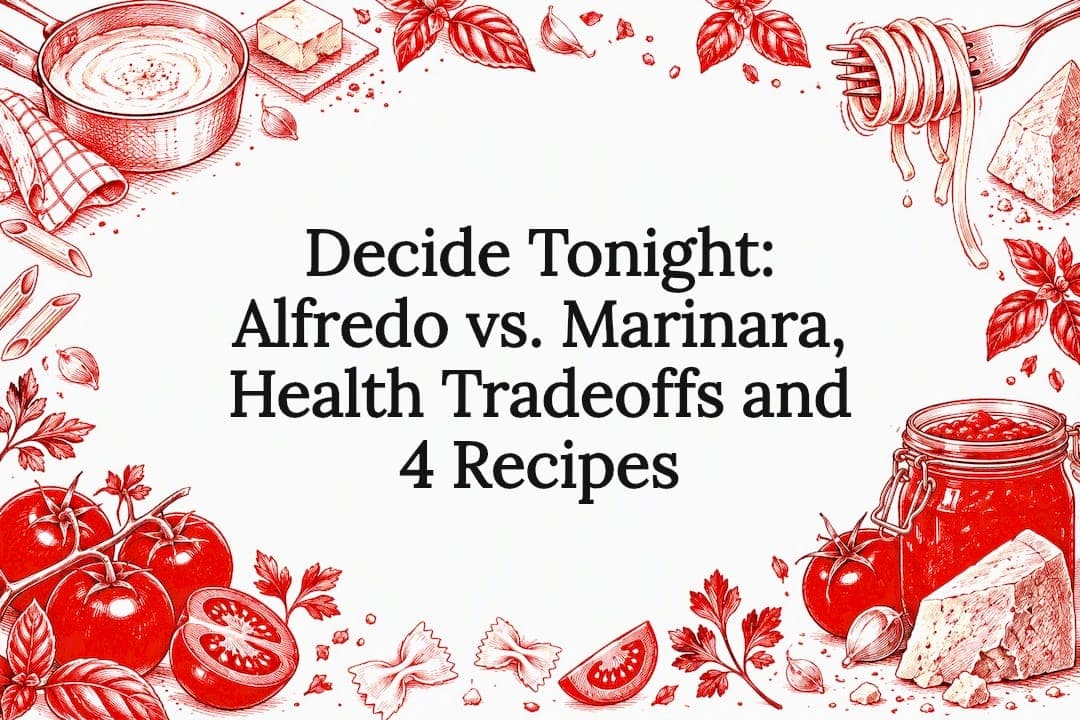
Choose marinara when you want a lighter, vegetable-forward plate with tomato and lycopene benefits, and choose Alfredo when you're craving something rich and creamy. Pink sauce, a blend of the two, works well when you want both. Your pick should come down to how rich you want the meal to taste and whether saturated fat or calories are on your mind tonight.
TL;DR:
- Alfredo sauce is higher in calories and saturated fat due to its dairy ingredients, making it less suitable for those watching fat intake.
- Marinara provides lycopene and antioxidants from cooked tomatoes, offering potential health benefits and a lower calorie profile.
- Both sauces often contain added sodium, especially in jarred versions, and dairy-sensitive individuals should prefer marinara.
- Correct pairing involves wide noodles like fettuccine for Alfredo and tubular or ridged pasta for marinara to optimize flavor and texture.
- Pink sauce combines Alfredo and marinara for a balanced option, ideal when sharing dishes among diners with different preferences or dietary needs.
Table of Contents
- What Alfredo and marinara actually are
- How the two sauces stack up on calories, fat, and sodium
- Why these sauces taste so different, and what to pair them with
- A quick checklist for picking your sauce tonight
- How to make each sauce at home tonight
- Our take on how guests actually choose
- Try both sauces without leaving your couch
- FAQ
- Sources
What Alfredo and marinara actually are
Alfredo and marinara sit on opposite ends of the sauce spectrum, and their ingredient lists explain why. True Roman Alfredo is butter, Parmesan, and starchy pasta water whisked into a glossy coating, while the Italian-American version most of us grew up with leans on heavy cream for its body, as Serious Eats explains. Marinara, by contrast, is a quick tomato sauce built from crushed or canned tomatoes, olive oil, garlic, and herbs, simmered just long enough to pull the flavors together.
- Roman Alfredo: butter, Parmigiano-Reggiano, pasta water, black pepper.
- Italian-American Alfredo: heavy cream, butter, Parmesan, often a thickener like flour or cornstarch.
- Marinara: tomatoes, olive oil, garlic, basil or oregano, sometimes a pinch of red pepper flake.
Jarred versions of either sauce often diverge from these basics. Commercial Alfredo frequently adds stabilizers to keep the dairy from separating on the shelf, and jarred marinara can carry more added sugar and sodium than a quick homemade batch.
How the two sauces stack up on calories, fat, and sodium
The nutrition gap between these two sauces comes down to what's doing the heavy lifting. Alfredo's richness comes from dairy fat, so it runs higher in calories and saturated fat, largely from the heavy cream, butter, and cheese that give it that coating texture. The American Heart Association recommends limiting saturated fat intake, and a cream-based Alfredo is the kind of dish that guidance has in mind.
Marinara's profile looks different because tomatoes are doing the work instead of dairy. A systematic review on PubMed links higher tomato and lycopene intake with reduced risk for several health outcomes, including some cancers, and notes that cooked tomato products increase how much lycopene your body actually absorbs. That's a point in marinara's favor for anyone building meals around produce rather than dairy.

Cooked tomatoes raise lycopene availability, which is one reason nutrition research treats simmered tomato sauce as more than just a flavor base.
A few practical notes apply to both sauces regardless of which you pick:
- Jarred sauces, Alfredo or marinara, tend to carry more sodium than a batch made at home.
- People managing alpha-gal syndrome need to check labels carefully, since CDC guidance notes that mammalian dairy and meat products can trigger reactions.
- Dairy-sensitive eaters should treat Alfredo as the higher-risk choice, given its reliance on cream and cheese.
Why these sauces taste so different, and what to pair them with
Texture and acidity explain most of the flavor gap. Alfredo coats the tongue with a smooth, fatty richness that clings best to wide, flat noodles like fettuccine, where the sauce has surface area to grip. Marinara brings bright acidity that cuts through richer proteins instead of adding to them, which is why it pairs naturally with meatballs, shellfish, or roasted vegetables, and why it's the backbone of a good pizza.
- Alfredo works best with: fettuccine, shrimp or chicken, simple steamed vegetables.
- Marinara works best with: penne or spaghetti, meatballs, shellfish, roasted eggplant or zucchini.
Matching sauce viscosity to pasta shape matters more than most home cooks realize. A thin marinara slips off ridged or tubular pasta, while a thick Alfredo can overwhelm delicate strands.
Pro Tip: Toss pasta directly in the sauce pan off the heat for a few seconds before plating. It helps the sauce grip the noodles instead of pooling at the bottom of the bowl.

A quick checklist for picking your sauce tonight
Run through these questions before you decide, and you'll land on the right sauce faster than scrolling through a menu.
- Watching calories or saturated fat? Lean toward marinara.
- Craving something rich and comforting? Alfredo delivers that in a way marinara can't.
- Managing a dairy sensitivity or alpha-gal concern? Marinara sidesteps the dairy question entirely.
- Can't decide? Order pink sauce, or ask for a half-and-half plate if you're splitting a table.
- Portion control matters? Stick to a modest serving of Alfredo sauce and bulk up the plate with vegetables or a side salad instead of extra sauce.
At a gathering, offering both sauces side by side, or a middle-ground pink version, lets everyone build the plate that fits their appetite without anyone feeling shorted.
How to make each sauce at home tonight
None of these recipes require special equipment, just attention to a couple of details that make or break the texture.
- Roman Alfredo: melt butter in a pan, add cooked pasta with a splash of starchy pasta water, then toss in grated Parmesan off the heat until it turns glossy, following the technique Serious Eats uses for emulsifying fat and cheese without cream.
- Lighter Alfredo: cut the cream by half and replace it with extra pasta water for body, a swap Serious Eats' Alfredo taste test notes keeps the sauce silky without doubling down on saturated fat.
- Quick marinara: sauté garlic in olive oil, add canned crushed tomatoes, simmer 15 to 20 minutes, and finish with torn basil.
- Pink sauce: stir equal parts of your finished Alfredo and marinara together over low heat until combined.
Pro Tip: Add your olive oil to the marinara while it simmers rather than at the end. A bit of fat alongside cooked tomatoes helps your body absorb more lycopene.
Our take on how guests actually choose
Most nights, we see Alfredo ordered for comfort and marinara ordered out of habit or health-mindedness, and both instincts are reasonable. Dairy-sensitive guests should flag it when ordering, and halal upon request is available for anyone who asks. Ordering direct at zioals.com keeps things simple and often cheaper than a delivery app.
— Zio Al's Team
Try both sauces without leaving your couch
We make our dough fresh in-house every day, and we're open until 3 AM, 365 days a year, holidays included, so a craving for rich Alfredo or bright marinara never has to wait until tomorrow.
- Order pasta with Alfredo, marinara, or a pink blend straight from our menu.
- Planning a group order or office lunch? Our catering packages can include both sauces so nobody has to compromise.
- Ordering direct at zioals.com or through the Zio Al's app gets you 15% off your first app order, no delivery app markup attached.
Skip the extra fees and order direct at Zioals tonight.
FAQ
Is Alfredo sauce better than marinara?
Neither sauce is objectively better. Marinara is the lighter, lower-calorie option with tomato and lycopene benefits, while Alfredo delivers richness that fits an indulgent meal, so the better choice depends on your goal for that plate.
Is pink sauce just Alfredo and marinara mixed together?
Yes, pink or rosa sauce is a blend of Alfredo and marinara, combined to balance creaminess with tomato brightness, as described in Serious Eats' sauce guide. It's a practical middle ground when a table can't agree on one sauce.
Is red sauce better for you than Alfredo?
Marinara generally contains less saturated fat and fewer calories than cream-based Alfredo, since it's built on tomatoes and olive oil rather than cream, butter, and cheese. The American Heart Association recommends limiting saturated fat, which weighs in marinara's favor for most eaters.
What's it called when you mix marinara with Alfredo?
That combination is called pink sauce or rosa sauce. It's a common compromise for diners who want some creaminess without the full richness of straight Alfredo.