The fastest, most reliable way to order halal food online is to go straight to a halal-friendly restaurant's own app or website first, especially after 10 PM when kitchens start turning away last-minute orders. If direct ordering isn't available where you are, open a major delivery platform, filter for "open now," and schedule a pre-order to lock in your slot. Zio Al's Pizza & Pasta offers exactly this kind of direct route, with late-night hours and a rewards app across its DFW locations.
TL;DR:
- Ordering directly from a restaurant's app or website ensures faster, more reliable delivery and often provides loyalty discounts, especially late at night.
- Delivery dishes like pizza, baked pasta, wings, rice bowls, and hearty sandwiches travel well and tend to arrive hot, while fragile foods like fries and sushi should be avoided for late-night orders.
- Halal claims should be verified by checking for a certifier and certificate number or contacting the restaurant directly, since app labels alone often lack third-party verification.
- Pre-ordering at least 30 to 45 minutes before closing and tipping more than usual improves chances of late-night delivery success and faster service.
- Using the restaurant's own app for ordering is preferable when available, but mainstream platforms are useful for wider coverage or odd hours, with dedicated halal apps offering more trustworthiness in verification.
Table of Contents
- How to Order Halal Food Online, Step by Step
- What to Order Late at Night That Actually Travels Well
- How Do You Verify Halal Claims When Ordering Online?
- Late-Night Ordering Tips That Actually Save You Money and Headaches
- What Payment Methods Do Halal Restaurants and Apps Accept?
- Handling Dietary Preferences and Allergies When Ordering Halal Food
- Platform-Specific Pros and Cons for Halal Food Ordering
- Why Direct Ordering From a Local Halal Kitchen Matters
- Order Late-Night Halal Pizza, Pasta, and Wings Directly From Zio Al's
- Sources
- FAQ
How to Order Halal Food Online, Step by Step
Ordering halal food online at midnight isn't the same as ordering at noon. Kitchens are winding down, delivery drivers are scarcer, and a few extra minutes of diligence saves you from a canceled order and a growling stomach. Here's the sequence that actually works.
- Check the restaurant's own app or site first. Direct ordering skips the middleman, often unlocks loyalty pricing, and gives the kitchen your order without a third-party buffer that can delay dispatch.
- Create an account and grab any first-time discount. Loyalty programs that unify your identity across web, app, and in-store visits tend to push more of your business toward direct orders, which usually means better rewards for you over time.
- If direct ordering isn't offered, open an aggregator app. Enter your address, toggle "open now," and check the delivery radius before you start browsing the menu, since some kitchens quietly shrink their delivery zone after 11 PM.
- Decide delivery or pickup based on distance and traffic. Pickup guarantees your food's temperature and timing; delivery late at night can slip if a driver has a long queue of stops ahead of you.
- Schedule a pre-order if you're not ready to eat yet. Locking in a time slot in advance reduces the odds your order gets refused near closing, since kitchens often stop accepting walk-in-style rush orders 30 to 45 minutes before they shut the lights off.
- Double-check everything before you hit checkout. Confirm your address and unit number, pick a payment method, and add any halal-specific notes or allergy flags in the delivery instructions field.
Pro Tip: Save your most-ordered items as a "favorite" in the restaurant's app if it offers one. At 1 AM, reordering your usual wings and pasta combo in three taps beats rebuilding your cart from scratch while you're half asleep.
What to Order Late at Night That Actually Travels Well
Not every dish survives a 20-minute ride in a delivery bag. Some foods practically improve with a little steam-trapped time; others turn into a sad, soggy version of themselves before they hit your porch.
- Pizza holds heat well under its own crust and stays intact in a standard delivery box, making it one of the safest late-night bets.
- Baked pastas like ziti or lasagna are already dense and moist, so they don't dry out or separate during transport.
- Wings travel well in sealed containers because the sauce clings to the meat instead of pooling and making everything soggy.
- Rice bowls keep their texture since rice retains moisture and heat far better than, say, a delicate salad.
- Hearty sandwiches and subs wrapped tightly hold their structure, especially when sauces are packed on the side.
- Shareable platters work well for groups because they're built for reheating and don't rely on a single perfect bite of freshness.
Skip fragile fries, which go limp within minutes, raw sushi, which has zero business surviving a 25-minute car ride, and heavily dressed salads, which turn to mush the second the dressing sits. Late-night delivery guidance consistently points to dishes that hold heat and structure, which is exactly why pizza and pasta dominate late-night orders nationwide.
If you're ordering for a group or a small event, lean into family-size trays instead of individual entrees. Schedule pickup rather than delivery when you're feeding six or more people, since a single large order is far easier for a kitchen to time correctly than five separate small ones arriving at once.
How Do You Verify Halal Claims When Ordering Online?
A "halal" label on a delivery app isn't a certification. It's a claim the restaurant typed in, and on many mainstream platforms, that label relies entirely on the restaurant's own word rather than any third-party check. That's not a criticism of any specific app. It's simply how most Western delivery marketplaces are built.
Here's what actually verifies a halal claim:
- Look for a named certifier and certificate number on the restaurant's website or menu page, such as IFANCA or a recognized local Islamic center.
- Ask whether the entire menu is certified or just specific items. A restaurant might have halal-certified chicken but a non-halal fryer shared with pork products, which changes everything.
- Message the restaurant directly through in-app chat with a simple, specific question: "Is your chicken halal-certified, and if so, which certifier covers it? Do you pack halal orders separately?"
- Check packaging and prep-line separation. Sealed containers and a dedicated prep area matter more for halal integrity than any badge on an app listing.
Mainstream delivery platforms vary widely on this. Verification depends heavily on the market, and a "halal" tag in one city might mean full certification while in another it means the restaurant simply self-reported the label with no audit at all.
Dedicated halal discovery platforms, including apps built specifically around halal restaurant verification, often check certificates or audit kitchens before listing a restaurant, which raises trust but usually narrows your options since coverage tends to be spotty outside major metro areas. When a fully halal-certified kitchen isn't listed on a dedicated platform near you, calling the restaurant directly or ordering through its own site remains the most reliable path.
Late-Night Ordering Tips That Actually Save You Money and Headaches
A few habits separate a smooth 1 AM order from a canceled one and a refund dispute.
- Pre-order well before posted closing time. Kitchens often stop accepting new tickets 30 to 45 minutes before close, so an order placed at 2:15 AM for a 2:30 AM kitchen shutdown is a coin flip.
- Tip a little more than you would at 7 PM. Late-night drivers are scarcer, and a stronger tip tends to get your order picked up faster when a driver is choosing between multiple deliveries.
- Bundle a side or upsize instead of placing two small orders. One larger order is easier for a kitchen to prepare correctly than two separate tickets arriving minutes apart.
- Use the restaurant's own app when you can. Skipping third-party delivery fees and ordering direct tends to translate into better value and faster order confirmation, and it's often where the real loyalty perks live.
- If your order gets canceled, act immediately. Call the restaurant directly, ask about a reorder or refund, and check the app's live tracking before assuming the food is simply lost in transit.
Pro Tip: If an app shows your order "preparing" for more than 15 minutes past the estimated time with no driver assigned, call the restaurant. A quick phone call resolves more late-night mix-ups than refreshing the tracking screen ever will.
What Payment Methods Do Halal Restaurants and Apps Accept?
Most halal-friendly restaurants and the apps that serve them accept the same core set of payment options you'd expect from any modern kitchen: major credit and debit cards, Apple Pay, Google Pay, and increasingly, in-app stored balances tied to loyalty rewards. Cash on delivery still shows up at some independent restaurants, though it's becoming less common as more kitchens shift toward fully cashless checkout.
Direct-ordering apps typically let you save a card on file, which speeds up the late-night reorder process considerably. Third-party aggregators usually support the same major cards plus their own in-app wallet systems, and some let you split payment between a gift card balance and a credit card.
If you're paying for a group order or catering, ask whether the restaurant accepts a single consolidated payment or requires separate transactions per person. Most catering-focused ordering pages default to one payment for the entire order, which simplifies things considerably when you're organizing food for an office or a family gathering. Contactless payment at pickup is also standard now at most halal restaurants that have modernized their point-of-sale systems, so tapping a card or phone at the counter works just as smoothly as paying online in advance.
Handling Dietary Preferences and Allergies When Ordering Halal Food
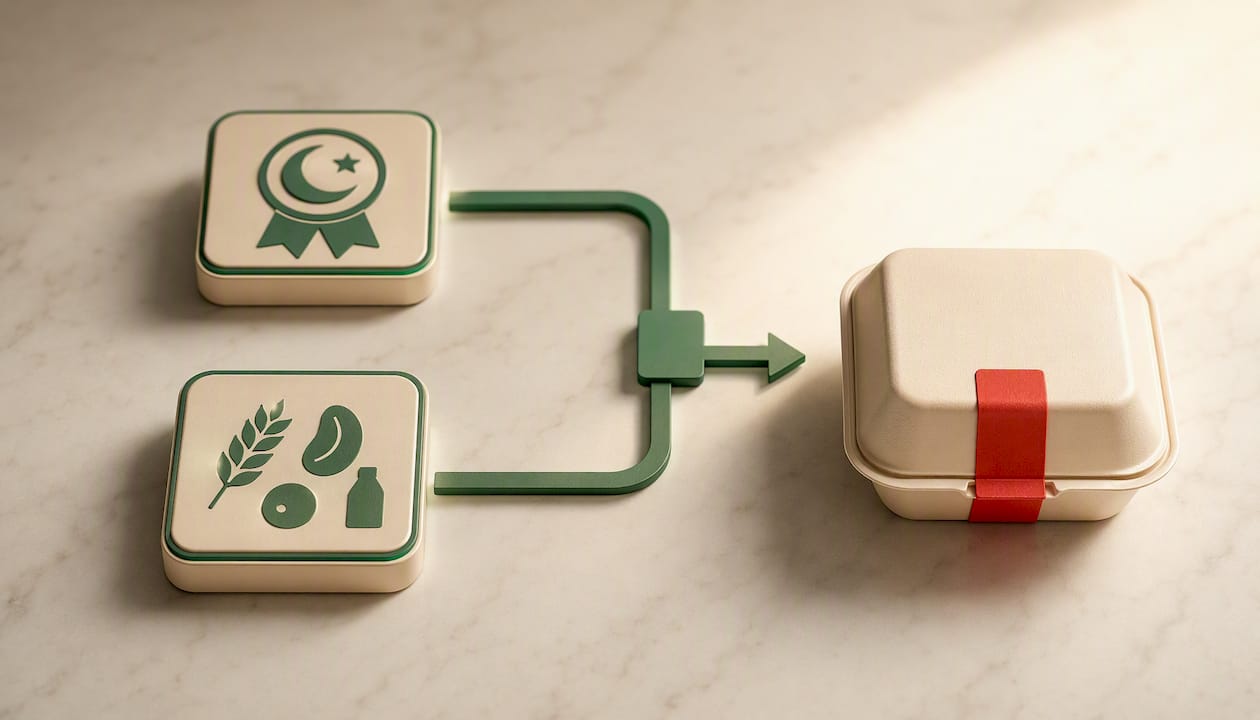
Halal status and allergy safety are two separate questions, and treating them as one is a common mistake. A dish can be fully halal-certified and still contain nuts, dairy, or gluten that matters just as much to your health as the halal label does.
Most online ordering systems include a notes field at checkout specifically for allergies or dietary flags. Use it plainly: "no peanuts," "gluten-free crust only," or "dairy-free, please confirm no butter in the sauce." Vague notes like "please be careful" don't give a kitchen enough to act on.
If an allergy is severe, a note in the checkout field isn't always enough. Call the restaurant directly before ordering and ask whether the specific dish is prepared on shared equipment with your allergen. This matters even more for halal diners managing something like a shellfish allergy alongside halal dietary requirements, since two separate restrictions are stacking on the same order.
For vegetarian or vegan halal diners, check the menu descriptions carefully rather than assuming a dish labeled "vegetable" is free of animal-based broths or sauces. When in doubt, the same in-app messaging or phone call that verifies halal certification scope can clarify ingredient details in the same conversation, saving you a second round of questions.
Platform-Specific Pros and Cons for Halal Food Ordering
Every ordering channel makes a tradeoff between reach and reliability, and knowing which one you're using changes what you should expect.
Direct restaurant apps and websites tend to offer the most accurate halal information, since you're getting it straight from the kitchen, plus loyalty discounts and faster reorder speed. The tradeoff is coverage. If the restaurant you want isn't nearby or doesn't have a location near you, direct ordering simply isn't an option.
Major mainstream delivery platforms offer broad restaurant selection and convenient "open now" filtering, which matters a lot at 1 AM when half the map on your screen has already gone dark. Their downside is that halal labeling on these platforms often relies on restaurant self-declaration rather than independent verification, so the label alone isn't proof.
Dedicated halal discovery apps solve the verification problem by checking certificates before listing a restaurant, giving you more confidence in the halal claim itself. Their limitation is geographic coverage, since many U.S. markets simply don't have enough listed restaurants to make the app your only option every night of the week.
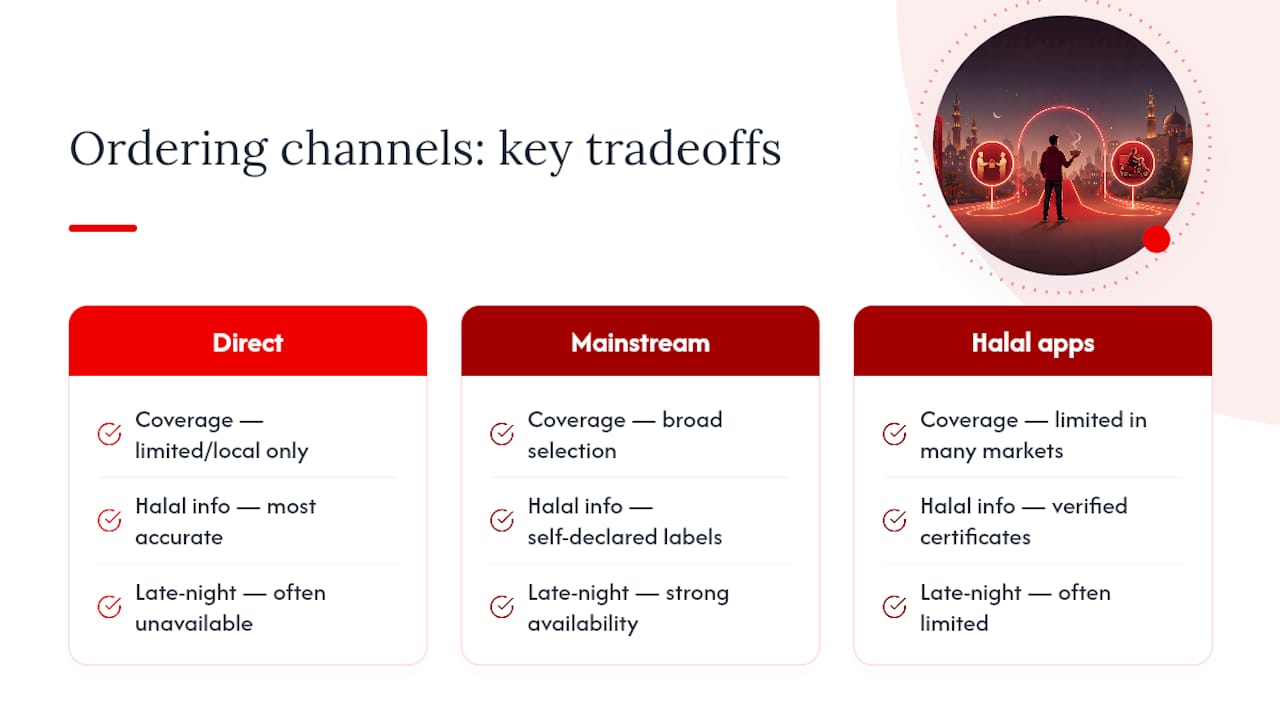
The most practical approach combines direct ordering when it's available with a mainstream app as backup for broader coverage or unusual hours.
Why Direct Ordering From a Local Halal Kitchen Matters
Late-night halal dining has quietly become its own category, and the restaurants that do it well tend to share three traits: multiple accessible locations, a menu built fresh rather than reheated, and a direct ordering system that rewards loyalty instead of just processing transactions. Some restaurants fit that pattern with multiple accessible locations and a halal-friendly menu of pizza, pasta, and wings served late into the night.
First-party ordering tends to beat third-party apps on reliability because the restaurant controls the entire chain, from kitchen ticket to delivery dispatch, without a middleman's routing logic in between. That said, a mainstream delivery app still earns its place when you're outside a direct-order restaurant's coverage area or need a wider net at 2 AM. Use both tools, but default to direct ordering when it's on the table.
— Id
Order Late-Night Halal Pizza, Pasta, and Wings Directly From Zio Al's
Skip the third-party fees and the guesswork over halal labeling. Zio Al's makes its entire halal-friendly menu, pizza, pasta, wings, subs, and salads, fresh to order at locations open until 3 AM across the DFW Metroplex, and ordering directly through the Zio Al's app gets first-time users 15% off right out of the gate.
Craving something specific tonight? Browse the full menu and place your order directly through Zio Al's primary ordering page, or check hours and pickup windows at your nearest location, including Plano or Cedar Springs. Planning a bigger event? Zio Al's catering packages cover group orders and office gatherings with the same fresh-made halal menu, and scheduling pickup in advance keeps everything hot and on time. Download the rewards app, redeem your first-order discount, and place your next late-night order straight from the source.
Sources
For readers who want to dig deeper into loyalty-driven ordering and halal verification, the restaurant loyalty program guide from Chowly breaks down how direct ordering builds repeat business, while Grubhub's late-night delivery guide covers timing strategy in more detail. For certification questions specifically, the halal food delivery apps guide explains how verification varies by platform and region.
- Restaurant loyalty programs
- The essential guide to ordering late night delivery
- Halal food delivery apps: complete guide for consumers & restaurants
FAQ
Is It Better to Order Halal Food Directly or Through a Delivery App?
Direct ordering through a restaurant's own app or site is usually more reliable and often comes with loyalty perks, since it skips third-party fees and gives the kitchen full control over your order. Delivery apps still make sense when a restaurant isn't available directly or you need "open now" filtering across a wider area.
How Do I Know if a Restaurant's Halal Claim Is Legitimate?
Look for a named certifier and certificate number on the restaurant's site, and ask directly whether the entire menu is certified or just specific items. Many mainstream delivery platforms rely on restaurant self-declaration rather than independent audits, so a label alone isn't proof.
What Time Should I Order to Guarantee Late-Night Delivery?
Place your order at least 30 to 45 minutes before the restaurant's posted closing time, since most kitchens stop accepting new tickets before they actually shut down. Pre-ordering or scheduling ahead further reduces the risk of a canceled order.
Does Zio Al's Offer Online Ordering and a Loyalty App?
Yes, Zio Al's offers direct online ordering through its own app, with locations across DFW open until 3 AM serving fresh halal pizza, pasta, and wings. First-time users get 15% off through the Zio Al's ordering page.
Can I Order Catering Online for a Group or Event?
Yes, most halal restaurants that offer catering, including Zio Al's, let you place group orders online through a dedicated catering page. Scheduling pickup 45 to 60 minutes before your event start time keeps food hot and gives the kitchen enough lead time to prepare larger quantities.