The standard rule is 2 ounces (56 grams) of dry pasta per person if you're following US nutrition labels, but most home cooks and Italian kitchens land closer to 80 to 100 grams (about 3 to 3.5 ounces) when pasta is the main event. Go lighter for a side dish, a kid's plate, or a rich cream sauce. Go heavier for big appetites or a lean, brothy sauce that needs more noodle to soak it up.
TL;DR:
- A standard main-course portion of dry pasta is about 80 to 100 grams (3 to 3.5 ounces), which yields roughly 1.75 to 2 cups cooked.
- Short shapes like penne or fusilli require about 2 ounces (56 grams) dry per half cup for accurate measurement, though a scale is best.
- Cooking for a crowd involves about 85 grams (3 ounces) dry pasta per adult, with larger amounts for big appetites or lean sauces; adjust quantities based on servings needed.
- Going the catering route simplifies portioning, as professional kitchens weigh precise amounts, and ordering for large groups avoids the need for individual measurement and guesswork.
Table of Contents
- Pasta Per Person Cheat Sheet by Situation
- How Do You Measure Pasta Without Guessing?
- How Do You Adjust Portions for Different Situations?
- How Much Does Pasta Yield After Cooking?
- How Do You Scale Pasta for a Crowd?
- How Restaurants Standardize Pasta Portions
- The One Habit That Fixes Most Pasta Portioning Mistakes
- When It's Easier to Skip Cooking Altogether
- Sources
- FAQ
Pasta Per Person Cheat Sheet by Situation
The gap between the nutrition-label serving and what actually lands on a dinner plate trips up more cooks than any other kitchen math. Here's the fast reference, broken down by how the pasta is being served and what shape you're working with.
| Situation | Dry weight | Ounces | Approx. cooked cups |
|---|---|---|---|
| Small first course (primo) | About 60 g | About 2 oz | About 1 cup |
| Standard main (nutrition label) | 56 g | 2 oz | About 1 to 1.5 cups |
| Standard main (home-cook/Italian) | About 80 to 100 g | About 3 to 3.5 oz | About 1.75 to 2 cups |
| Hearty main, big appetite | About 110 g | About 4 oz | About 2.5 cups |
| Fresh egg pasta | About 75 g | About 2.6 oz | About 1.5 cups |
| Filled pasta (ravioli, tortellini) | About 120 g | About 4.3 oz | Varies by filling |
| Baked pasta / lasagna | About 60 g | About 2.1 oz | Pasta is structural, not bulk |
A one-pound box (454 g) works out to roughly 4 generous main-course portions at 100 g each, or about 8 servings at the 56-gram label standard.
A few shape-specific notes worth pinning to the fridge:
- Short shapes like penne or fusilli pack loosely or tightly depending on how you scoop, so cup measurements swing more than they do with long noodles.
- Filled pasta portions run heavier because you're weighing the wrapper and the filling together, not just starch.
- Baked dishes need less raw pasta per person since sauce, cheese, and other ingredients bulk up the final plate.
How Do You Measure Pasta Without Guessing?
A kitchen scale settles the short-shape debate for good. Set your empty bowl on the scale, hit tare, and pour until you hit the target weight. This works because short pasta shapes vary a lot by volume depending on how they settle in a cup, which means two "cups" of rigatoni can differ by 20 grams or more.
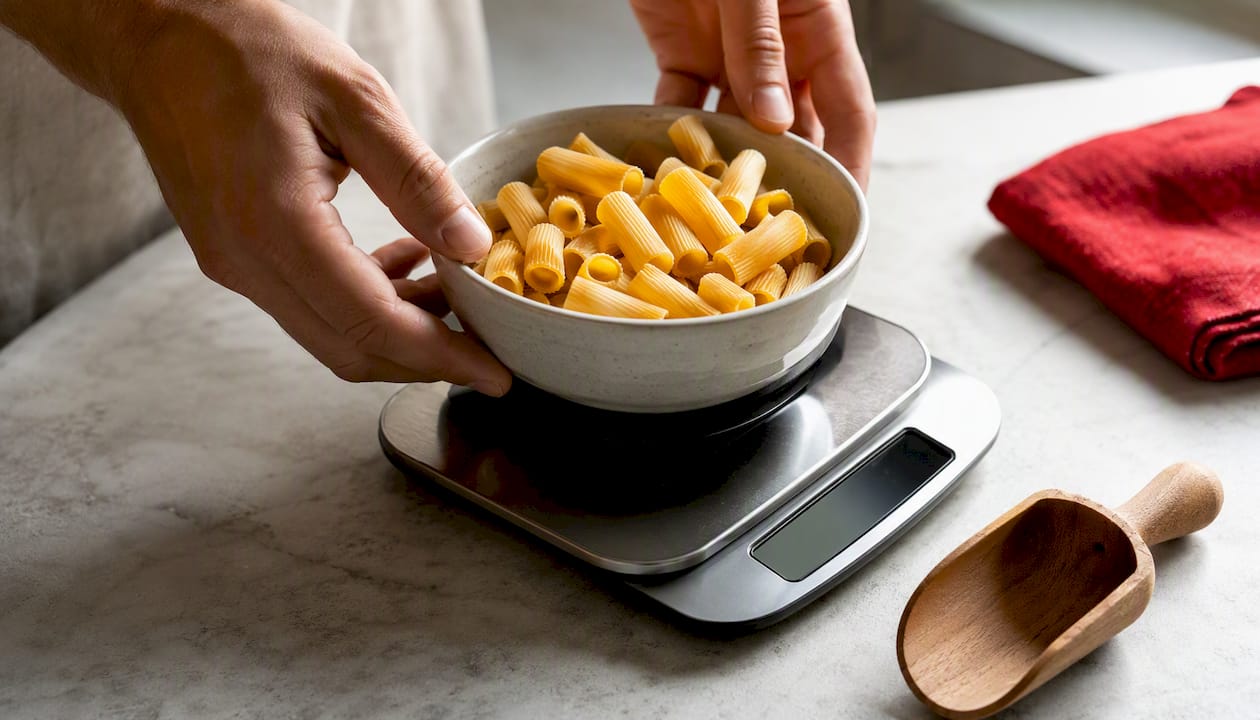
For shapes without a scale handy, rough cup equivalents help: 2 ounces of small shapes like elbow macaroni or fusilli is close to a half cup dry. Long pasta doesn't measure by cup at all, so most cooks break it or bundle it instead.
The spaghetti-bundle test is the classic trick, and Allrecipes breaks down the visual method clearly:
- Gather a bundle of dry spaghetti between your thumb and index finger, forming a circle.
- A bundle roughly the size of a quarter equals about 2 ounces, or one standard serving.
- A bundle closer to a US half dollar runs closer to 4 ounces, good for two people or one hungry adult.
- Compare your bundle against a coin before dropping it in the pot, since eyeballing alone tends to run short.
Pro Tip: Keep a $0.25 coin taped inside your pasta cabinet door. It sounds silly, but it's a faster gut check than pulling out a scale every single time.
How Do You Adjust Portions for Different Situations?
Once you know the baseline, adjusting for the situation is just multiplication. Use these rough multipliers against your standard 85-gram main-course portion:
- Main course: 1.0× (the baseline, roughly 85 grams)
- Side dish: 0.65× (about 55 grams)
- Kids' portion: 0.6× (about 50 grams)
- Big appetite or athlete: 1.3× (about 110 grams)
Sauce changes the math too.
Here's a worked example: hosting 3 adults and 2 kids for a main-course dinner. The kids count as 0.6 adult-equivalents each, so your total is 3 + (2 × 0.6) = 4.2 adult-equivalents. At 85 grams per adult-equivalent, that's about 357 grams, or roughly 12.5 ounces of dry pasta total.
How Much Does Pasta Yield After Cooking?
Dry pasta doesn't stay dry for long once it hits boiling water, and the jump in weight surprises a lot of first-time cooks.
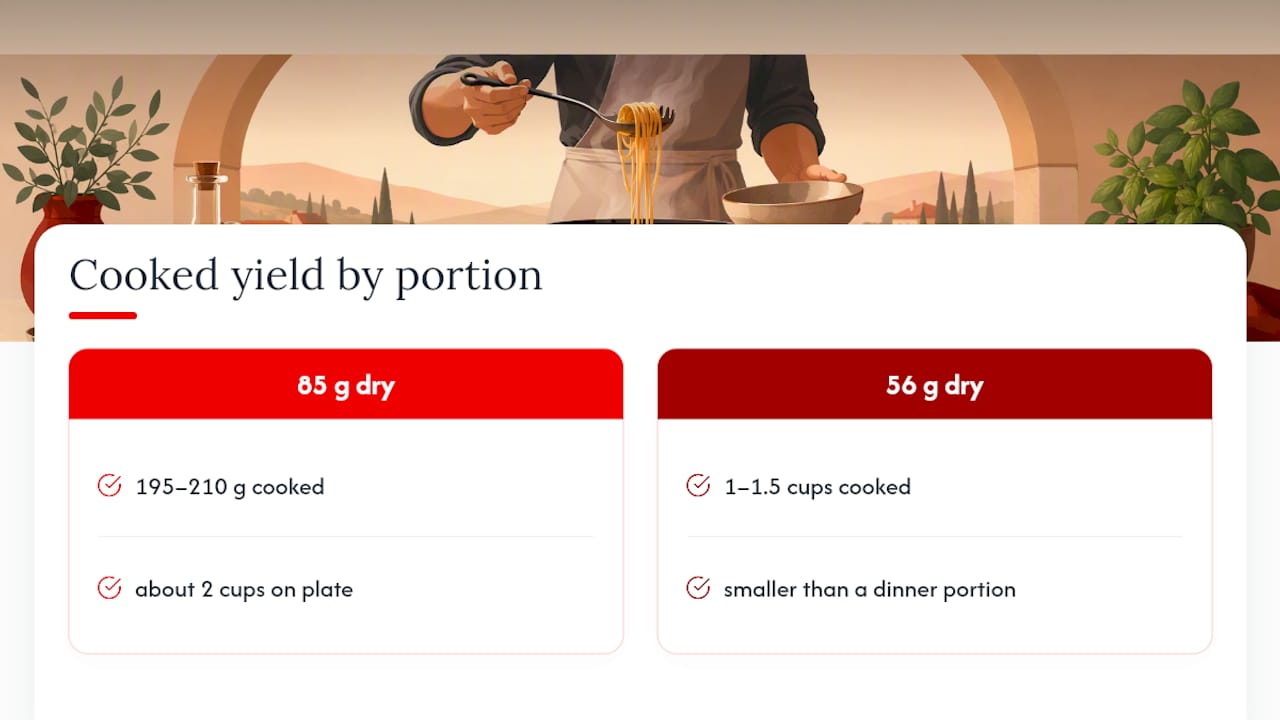
Dry pasta typically gains 2.2 to 2.5 times its weight when cooked. That means 85 grams dry turns into roughly 195 to 210 grams cooked, or about 2 cups on the plate. The 56-gram label serving lands closer to 1 to 1.5 cups cooked, which is exactly why that portion looks smaller than what most people expect for dinner.
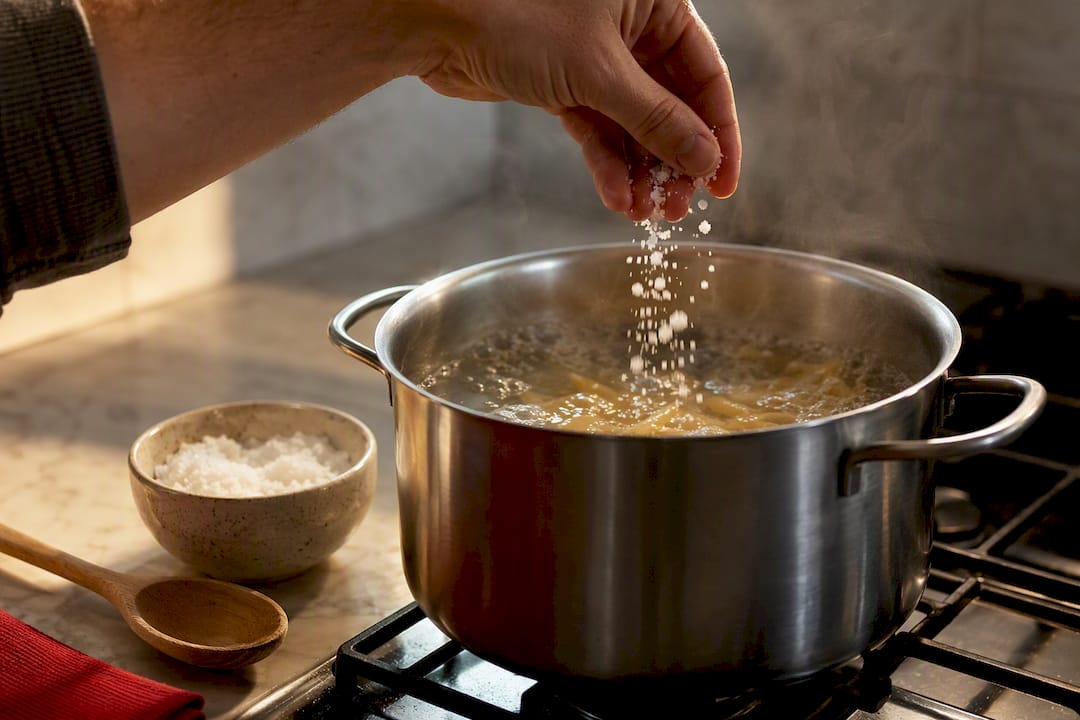
Water and salt matter more than most recipes admit. The standard ratio is 1 liter of water plus 10 grams of salt per 100 grams of dry pasta, seasoning the noodle itself rather than relying on the sauce to do all the work. Boil hard, stir in the first minute to stop sticking, skip the oil in the pot, and start tasting a minute before the package time says you're done.
How Do You Scale Pasta for a Crowd?
Cooking for a family dinner is one thing. Feeding a birthday party or a potluck is where the math either saves you or leaves half your guests staring at an empty pot.
- For 4 adults: a single 1-pound box (454 g) covers generous 100 to 110 gram main-course portions with a little left for seconds.
- For 10 adults: plan on 850 to 1,000 grams, or just under two 1-pound boxes, at the standard 85 to 100 gram range.
- For 20 people including kids: convert kids to 0.6 adult-equivalents first. Say 14 adults and 6 kids: 14 + (6 × 0.6) = 17.6 adult-equivalents, or about 1,500 grams (roughly 3.3 pounds) of dry pasta.
If sides like garlic bread or salad are heavy on the table, you can trim the pasta total slightly since guests won't fill up on noodles alone.
How Restaurants Standardize Pasta Portions
Guesswork doesn't scale in a working kitchen, which is a big part of why food-service operators lean on fixed weights instead of eyeballing scoops. A restaurant kitchen typically portions pasta by weighing a set amount per dish before it ever hits the pan, building in a small buffer so every plate that leaves the kitchen looks the same whether it's the first order of the night or the last.
That same discipline is worth borrowing when you're placing a catering order instead of cooking for a crowd yourself. Before you call in an order, have these answers ready:
- Total headcount, including kids if portions will be adjusted for them
- Whether guests prefer standard or generous portions
- Sauce preference, since heavier sauces change how far the pasta stretches
- Any sides you're ordering alongside the pasta
- Delivery timing and whether the food needs to stay warm until serving
Zio Al's builds catering packages around exactly this kind of headcount-and-preference conversation, which takes the portioning math off your plate entirely when you'd rather not run the numbers yourself.
The One Habit That Fixes Most Pasta Portioning Mistakes
Most portioning mistakes come down to eyeballing a handful of dry noodles and hoping for the best, or forgetting that a cream sauce needs less pasta than a light tomato sauce. The fix isn't complicated: keep a $10 kitchen scale and a printed cheat sheet taped inside the pasta cabinet. And if you overshoot anyway, leftover pasta reheats fine with a splash of water in a pan. Nothing wasted.
— Id
When It's Easier to Skip Cooking Altogether
Sometimes the smartest portion plan is not cooking at all. If you're hosting more than a handful of people, don't own a scale, or just don't have three burners free at once, ordering handles the math problem for you. Zio Al's is the alternative to spending your afternoon boiling water and stirring three pots at once: order catering with fresh-made pasta, pizza, and wings, and skip the grocery run, the scale, and the cleanup entirely.
When you place an order, just tell them your headcount, whether guests want standard or generous portions, and any sauce or side preferences, and the kitchen handles the rest. Zio Al's also serves several DFW locations until 3 AM, so late-night cravings and last-minute get-togethers aren't a problem either. First-time users get 15% off through the rewards app, which is worth grabbing before your first order. Head to Zioals to check your nearest location and place an order for pickup, delivery, or your next event.
Sources
A few references back up the numbers in this guide if you want to dig deeper on your own:
- How to measure pasta (MasterClass)
- Pasta Per Person (Dry Weight) Calculator|Calc (GlobalCalcs)
- How Much Dry Pasta Is a Portion? Visual Guides and Grams (NutritionHealthInfo)
FAQ
How much does 1 pound of pasta feed?
A 1-pound (454 g) box feeds about 4 adults at generous 100 to 110 gram main-course portions, or roughly 8 people at the 56-gram nutrition-label serving. Which number to use depends on whether pasta is the star of the meal or one dish among several.
How much pasta should I make for one person?
For a main course, plan on 80 to 100 grams (about 3 to 3.5 ounces) dry pasta per person if you're cooking a home-style Italian portion. If you're following the US nutrition-label standard, that drops to 2 ounces (56 grams), which cooks up to about 1 to 1.5 cups.
How many people does 1 cup of dry pasta serve?
One cup of dry pasta generally serves 1 to 2 people, depending on the shape and how full you want the plate. Short shapes like penne or fusilli measure closer to 2 ounces per half cup, so a full cup lands near the 80 to 100 gram home-cook portion for one hearty serving.
How much pasta do I need for 20 people?
For 20 adults at the standard home-cook portion, plan on about 1,500 grams (roughly 3.3 pounds) of dry pasta. If kids are part of the headcount, convert them to 0.6 adult-equivalents first to avoid over-ordering, the same adult-equivalent method used for smaller mixed groups.
Does Zio Al's offer catering for large groups?
Yes, Zio Al's catering packages are built for events and large orders, so you can skip the portioning math entirely. Reach out through the catering page with your headcount and preferences, and current pricing is available directly on the site.